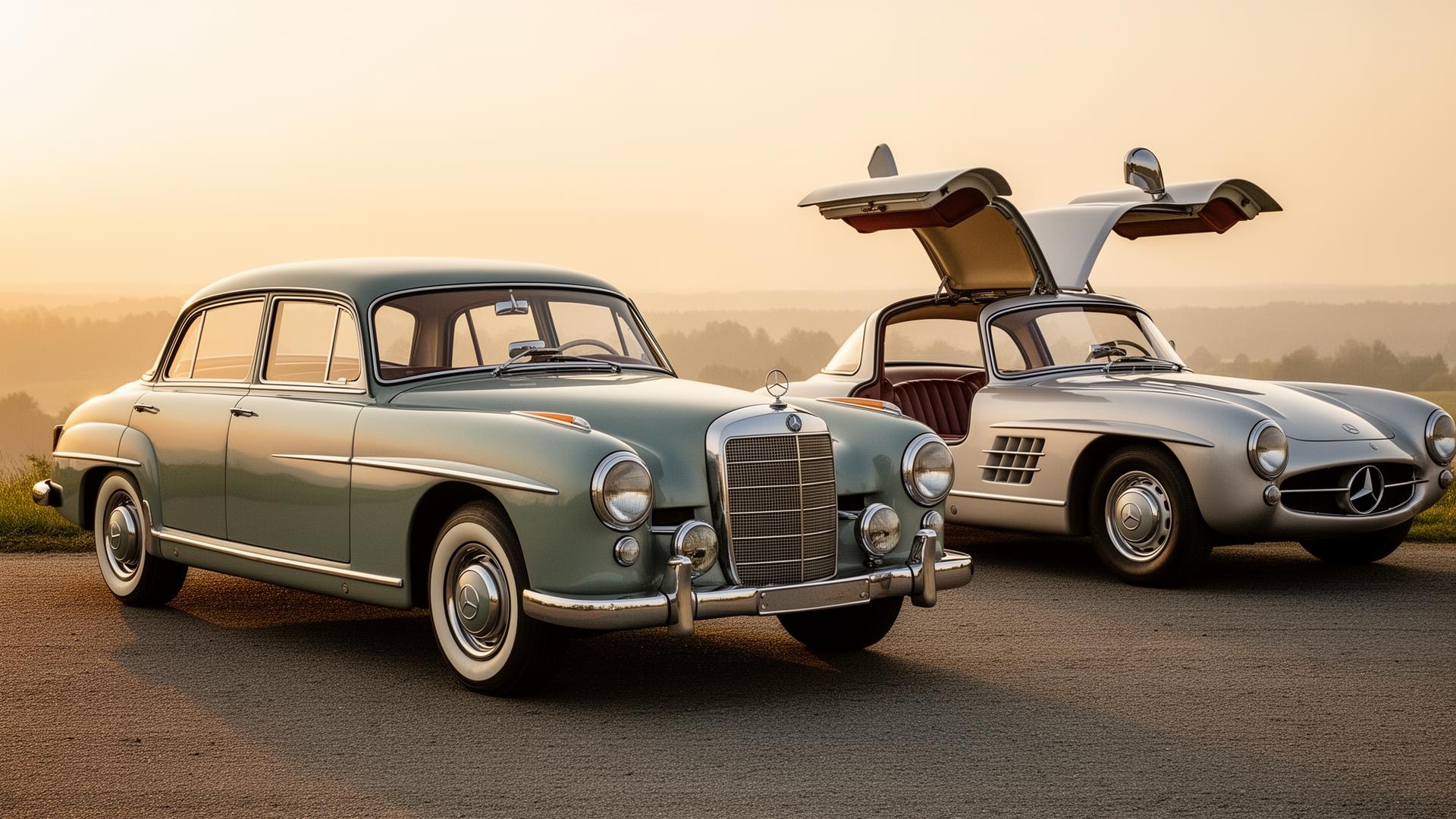
Post-War Recovery & the Ponton Era (1946–1959)
The "Ponton" (pontoon) body merged the fenders into a single integrated shell — replacing pre-war running boards and standalone wings. It was the design language that put Mercedes back on the world stage and made the brand modern. Alongside the sedans, the 300 SL Gullwing redefined what a fast road car could be.
Defining chassis
- W120 / W121 (1953–1962) — the 180 / 190 Ponton four-cylinder sedans; the practical backbone of the recovery years.
- W128 / W180 (1954–1959) — 220a / 220S / 220SE six-cylinder Pontons; the prestige spec, and the first Mercedes with mechanical fuel injection (220SE).
- W186 / W189 (1951–1962) — the 300 "Adenauer", hand-built flagship limousines for chancellors, kings, and the Pope.
- W198 (1954–1963) — the 300 SL Gullwing coupé and roadster. Tubular space frame, direct fuel injection, ~160 mph top speed. The world's first production car to break 150 mph.
- W121 BII (1955–1963) — the 190 SL, the affordable roadster sibling to the 300 SL.
Engine families
- M180 / M127 / M199 — the SOHC 2.2 and 3.0L inline-sixes; the M199 introduced Bosch mechanical direct injection to road cars via the 300 SL.
- OM621 — the 1.9L diesel four; the start of the OM6xx commercial-grade diesel dynasty.
Cultural & engineering notes
- The 300 SL's straight-six was canted 45° to the left to fit under the low hood — an engineering signature.
- The Ponton platform was the first Mercedes to use a true unibody-style integrated structure.
- Mechanical fuel injection moved from race cars to production sedans in this era — a decade ahead of competitors.